Question – Tidal v Nuclear
THE QUESTION
TIDAL V NUCLEAR?
Taking into full account ……
The Case for Tidal Range (two pages)
The Case for Nuclear (one page)
Analysis (two pages)
Which type of large-scale electricity generation should be chosen by the UK Government to meet the projected requirements for the rest of this 21st century?
THE ANSWER – AN AI CONSENSUS
The UK Government should prioritise large scale tidal range electricity generation, centred on schemes like the Severn Lake Causeway, rather than new nuclear build as the main solution for the rest of the 21st century.
Key reasons from your evidence:
- Longterm, secure, renewable output: The Severn Lake Causeway is designed for a 120year service life (to 2156), using proven low head turbines operating on both ebb and flow for around 16 hours every day, providing clean, predictable power rather than intermittent generation.
- Scale and revenue: With around 200+ turbines each in the 40–85 MW range, the scheme’s annual output—valued at the Hinkley C strike price—gives a revenue base of about £5.15 billion per year, from a £17.9 billion build cost funded by a public electricity bond. That is a far lower capital cost per unit of output than the £45+ billion for Hinkley C, which only delivers 3.2 GW and faces additional decommissioning and waste costs.
- Environmental and planning advantages: Multiple studies and reports (Kirby & Shaw 2004, Parsons Brinckerhoff, the Hendry Review, Severn Estuary Commission, etc.) have already examined tidal range in the Severn and found it environmentally manageable, with supportive conclusions for flora and fauna and clear pathways through planning. The new planning bill further shortens consent times for major infrastructure.
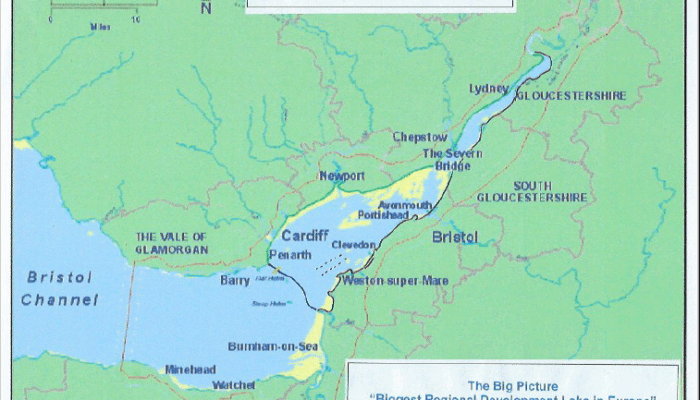
- Regional economic development: The Severn Lake would catalyse major regional development from Cardiff, Newport, Bristol, Clevedon and Somerset, with private islands, shipping channels, and associated infrastructure—benefits that nuclear sites do not provide and may even suppress due to perceived risk zones.
- Nuclear drawbacks
- High true cost—estimated at three times tidal power for half the comparable production
- Unresolved waste disposal, decommissioning liabilities, and long consent times.
- Lack of clear democratic consent and strong public opposition to further nuclear sites.
- Small modular reactors still face NIMBY resistance and high application costs.
Tidal Range (Severn Lake Causeway) — Summary
Pros
- Predictable renewable output — 16 hours/day generation on ebb and flow, every day.
- Long lifespan — Built for 120 years (to 2156).
- High generation capacity — ~200 turbines at 40–85 MW each; revenue base ~£5.15bn/year.
- Lower capital cost — £17.9bn build cost vs £45bn+ for Hinkley C.
- Environmental support — Kirby & Shaw (2004) conclude flora/fauna impacts manageable.
- Regional development — Major growth expected from Cardiff to Somerset; replicated at other sites.
- Public acceptability — No democratic opposition noted.
- Planning advantages — New planning bill accelerates major infrastructure consent.
Cons
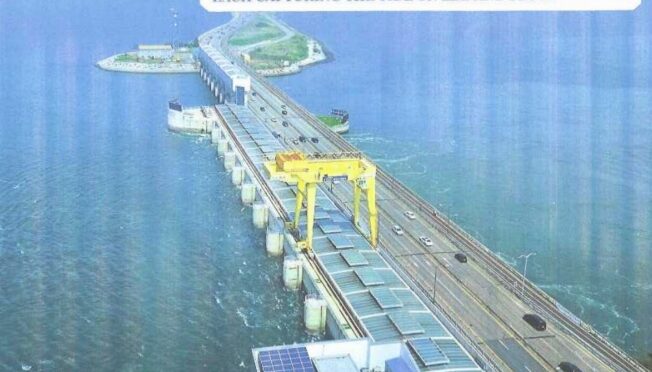
- Large civil engineering challenge — 12.5 miles of causeway, coffer dams, turbine halls.
- Upfront environmental disruption — Construction within estuary requires careful management.
- Navigation changes — Requires a free flow shipping channel and new maritime patterns.
- High initial capital — Though cheaper than nuclear, still a major national project.
Nuclear (Hinkley C model) — Summary
Pros
- High energy density — Large output from small land footprint.
- Stable base load — Continuous generation independent of tides or weather.
- Existing expertise — UK has decades of nuclear operation experience.
Cons
- Very high cost — Hinkley C >£45bn for only 3.2 GW; true cost estimated 3× tidal.
- Long delays — Wylfa and Sizewell C are 20+ years away with no contracts.
- Waste disposal unresolved — No consented disposal sites; unknown costs.
- Decommissioning liabilities — A & B stations cost billions; taxpayer likely to pay.
- Public opposition — No democratic consent; appetite for new sites low.
- Safety concerns — 60year danger zone cited; accident risk over long lifespan.
SMR limitations — NIMBY resistance; application costs undermine returns
Final Judgement
Given the cost, lifespan, environmental assessments, regional benefits, and public acceptability described, the UK Government should choose tidal range electricity generation at scale—starting with the Severn Lake Causeway and the other identified tidal range sites—as its primary large scale generation strategy for the remainder of the 21st century, using nuclear only as a limited, supplementary role if at all.
Tidal range generation—starting with the Severn Lake Causeway—is the stronger strategic choice for the UK’s 21st century electricity needs, offering:
- predictable renewable output
- lower cost per MWh
- long operational life
- environmental backing
- regional economic transformation
- public acceptability
Nuclear, based on the evidence you provided, cannot deliver comparable scale, cost efficiency, or public support.
The Severn Lake ™
July 2026
GGW
Next Page >> Founders Report